
In the first seven and a half months of 2026, Indian startups raised approximately ₹46,013 Cr (~US$4.8B) across 890 Seed, Series A and Series B rounds. That headline figure gets repeated in every roundup of Indian startup funding trends — but it says almost nothing about where the money actually went, or why.
At FinVal Research & Consultancy, we went beyond the headline number. We analysed every one of the 890 funded companies to map India’s startup funding landscape for 2026 sector by sector: which categories attracted the most capital, what investors actually rewarded within each one, realistic Seed and Series A valuation benchmarks, and the most active venture capital investors in India this year.

⬇ Download the Full Report (PDF)
21 pages · sector charts, valuation tables & investor benchmarks · free
Which sectors attracted the most startup funding in India in 2026?
Ranked by number of deals — the most reliable signal of investor appetite, and one we’ll return to below — these were the seven most active sectors in Indian startup funding in 2026, together accounting for 90% of all Seed-to-Series B activity:
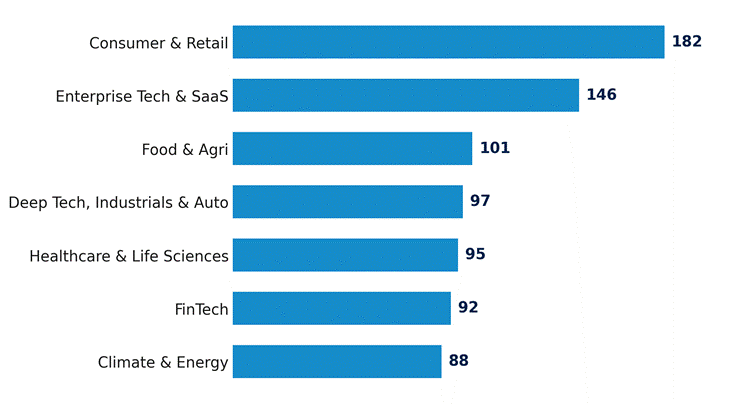
Number of Seed–Series B deals by sector, India, 2026 (890 total). Source: FinVal Research & Consultancy analysis of Tracxn data.
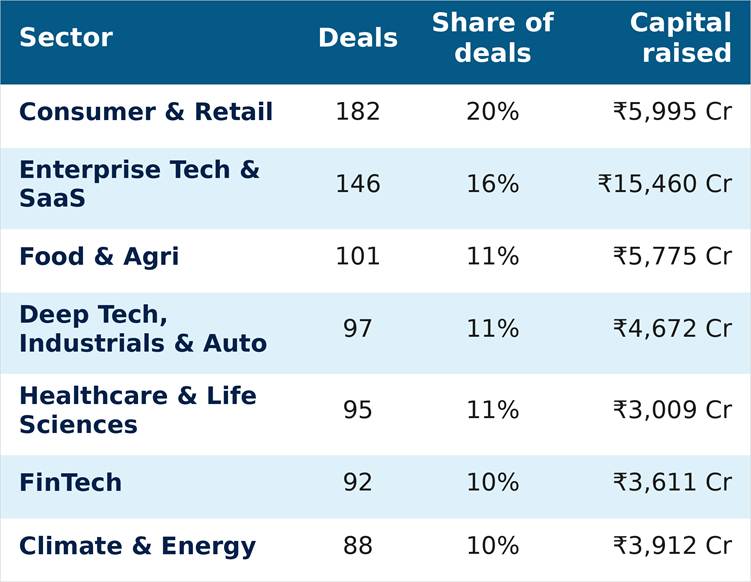
The remaining 10% of deals were spread across EdTech, Travel & Mobility, PropTech & Real Estate, and Media, Gaming & Telecom — smaller categories, each with its own distinct funding signal, covered in the full report.
Deal count vs. capital raised: why deal count is the reliable signal
Looking at capital raised alone, Enterprise Tech & SaaS appears to lead India’s 2026 venture capital activity with 33.6% of all money raised, versus Consumer & Retail’s 13%. That ranking is misleading. Three mega-deals — Neysa, Sarvam and Wingify — account for 63% of all capital raised across Enterprise Tech & SaaS’s 146 deals. Consumer & Retail’s ₹5,995 Cr, by contrast, is spread across many deals: its top three rounds make up just 19% of the sector total.
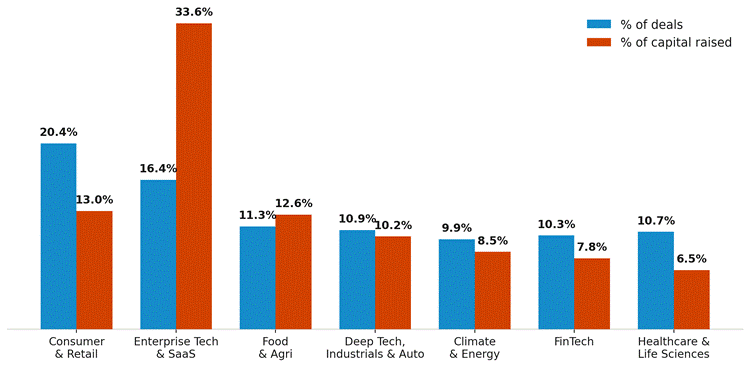
Percentage of deals vs. percentage of capital raised, by sector, India 2026. Source: FinVal Research & Consultancy analysis of Tracxn data.
Number of deals is a far steadier measure of investor appetite than capital raised, which a handful of outsized rounds can distort completely. If a sector “leads” funding headlines this year, it’s worth checking whether that reflects genuine breadth of investor interest or one or two outlier cheques.
What investors are actually rewarding, sector by sector
Ranking sectors is the easy part. We also read what each funded company does, to understand the specific sub-themes and business models investors are backing within each category:
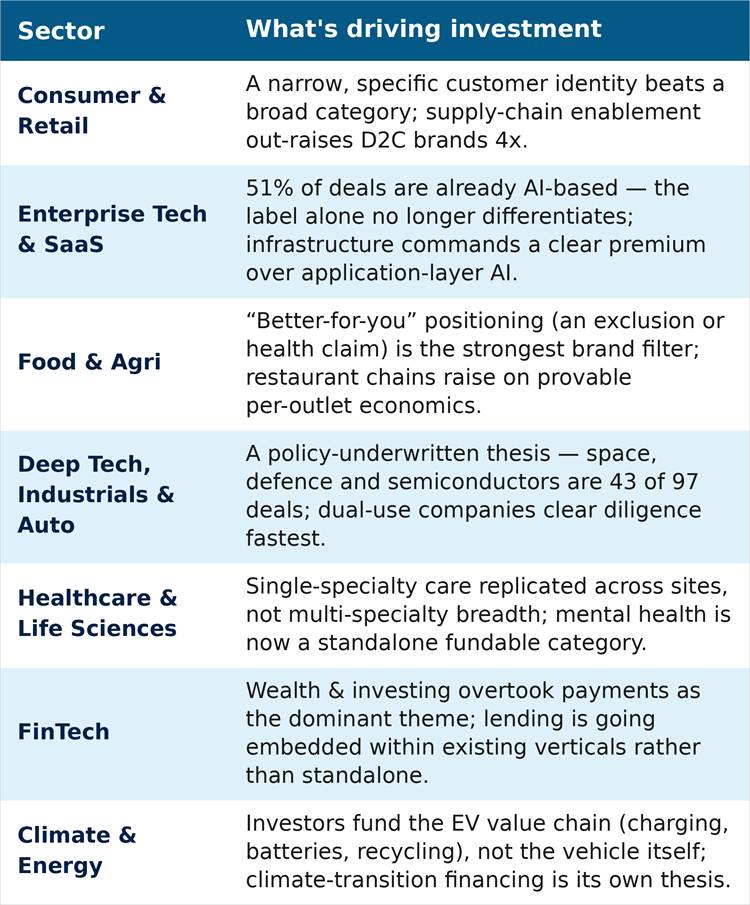
The full report breaks all 11 sectors down further into 48 specific funded sub-themes, each with example companies and median round size — available in the downloadable PDF and in dedicated sector-specific deep-dive decks.
Startup valuation benchmarks in India, 2026
Median post-money valuation by sector and funding stage. We use medians rather than averages throughout, since a handful of outlier rounds distort mean valuations significantly:
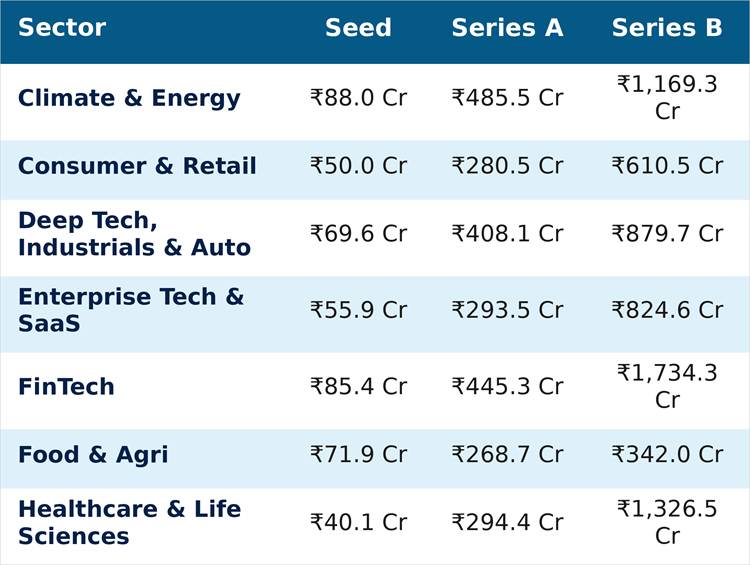
Post-money valuation is disclosed for only 39% of the 890 deals analysed, so several figures above rest on limited data and should be read as directional. Typical round size is a more reliable benchmark: the median Seed round in India in 2026 was ₹8.0 Cr (~US$0.8M), median Series A was ₹50.8 Cr (~US$5.3M), and median Series B was ₹123.8 Cr (~US$13.0M).
The most active startup investors in India, 2026
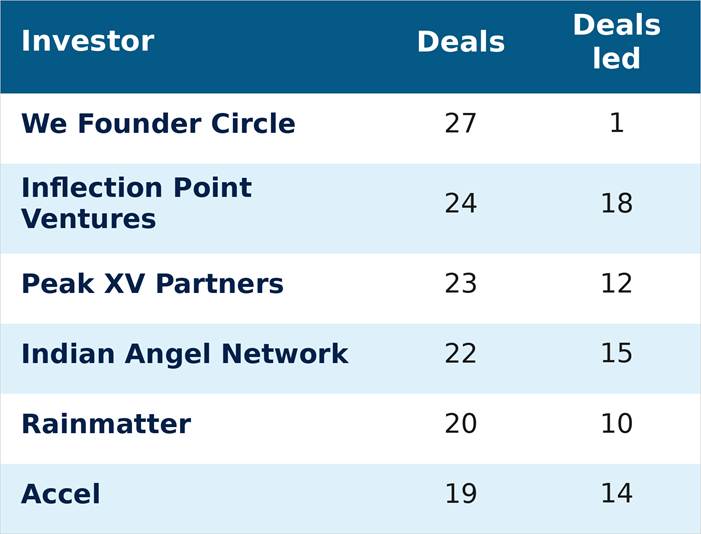
Angel-syndicate platforms — We Founder Circle, Inflection Point Ventures and Indian Angel Network — did more Seed-stage deals in 2026 than most traditional VC funds, confirming pooled angel capital is now a primary Seed channel in India. But deal volume and willingness to lead are different things: We Founder Circle led just 1 of its 27 deals, while Inflection Point Ventures led 18 of 24 — a distinction worth checking before building an investor target list.
Key takeaways for founders raising a Seed round in India
1. Anchor your ask to the real median. Half of all Seed rounds in India in 2026 were under ₹8 Cr.
2. The AI label alone isn’t a strategy. With 51% of Enterprise Tech deals already AI-based, differentiation now comes from a named, expensive workflow.
3. A specific customer beats a big market, especially in Consumer & Retail.
4. Target investors who lead, not just participate — check the lead-deal ratio before outreach.
5. Angel syndicates are a legitimate first stop, not a fallback, for Seed capital.
6. Benchmark valuation deal-by-deal, not against a sector-wide average.
7. Seed is not day-zero capital anymore — the median funded company was already 3 years old.
Want the full data behind every chart in this report?
21 pages covering all 12 sectors, full valuation tables, investor benchmarks and founder takeaways.
⬇ Download the Full Report (PDF)
Frequently asked questions
How much funding did Indian startups raise in 2026?
Indian startups raised approximately ₹46,013 Cr (~US$4.8B) across 890 Seed, Series A and Series B rounds between January 1 and August 13, 2026.
Which sector received the most startup funding in India in 2026?
By number of deals, Consumer & Retail led with 182 deals (20% of the market). By capital raised, Enterprise Tech & SaaS led, though that ranking was driven by three outsized rounds making up 63% of the sector’s total capital.
What is a typical Seed round size in India in 2026?
The median Seed round in India in 2026 was ₹8.0 Cr (~US$0.8M), with the 25th–75th percentile range at ₹2.4–19.0 Cr.
Who are the most active startup investors in India in 2026?
We Founder Circle, Inflection Point Ventures, Peak XV Partners, Indian Angel Network, Rainmatter and Accel were the most active institutional investors by deal count in 2026.
This analysis is based on a Tracxn funding-round export covering Seed, Series A and Series B deals in India, pulled August 13, 2026, deduplicated to 890 unique deals. Full methodology is available in the downloadable PDF report. Prepared by FinVal Research & Consultancy.