
Semiconductor chips power modern technology like drones, self-driving cars, and mobile phones. Taiwan, China, the US, South Korea, and Japan dominate semiconductor manufacturing.
India’s domestic semiconductor market expected to triple from US$38 billion in 2023 to US$109 billion by 2030. India is the second largest purchaser of semiconductor chips globally, relying heavily on imports from nations such as the USA, Japan, and Taiwan to fulfil its needs.
India plans to launch its first domestically produced semiconductor chip by the end of 2025, using 28 to 90 nanometre technology. As of May 2025, at least eight chip fabrication units are being developed at various stages of development. This marks a significant step in the country’s semiconductor mission, initiated in 2022. The initiative targets a segment that covers about 60 percent of global semiconductor demand, focusing on applications in the automotive, telecom, power, and railway sectors.
Here’s a snapshot of the major projects underway:
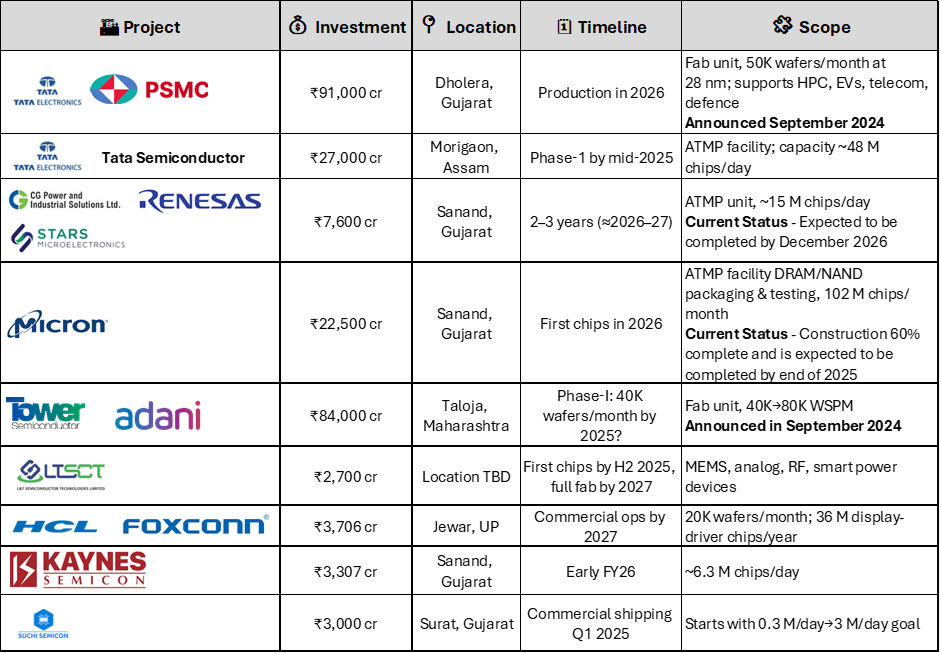
Why it matters:
- Supply-chain shift – Moving beyond design-centric to include fab & packaging.
- Geopolitical resilience – Diversifying from Taiwan/SK/China dependence.
- Skill & job creation – ~30K direct + 80K indirect roles through these initiatives
- State-led synergy – SEZ relaxations in Gujarat, Karnataka, UP and proactive policy collaboration.
India’s semiconductor ecosystem is undergoing significant transformation — driven by substantial investments, strategic incentives (₹76K crore PLI/ISM package), and progressive state support.
Key Initiatives Taken by the Government:
- Semicon India Program: The “Semicon India Program” was authorized by the Government in December 2021 to promote a sustainable semiconductor and display manufacturing ecosystem in India.
- India Semiconductor Mission (ISM): The Government established the India Semiconductor Mission (“ISM”) to encourage semiconductor companies to set up operations in India, achieve long-term goals, and facilitate development.
- Schemes: Starting in 2021, the Government launched several schemes to foster significant investments in the establishment of facilities in India.
- Incentives by State Governments: Uttar Pradesh, Gujarat, and Odisha state governments have endorsed various semiconductor policies to ensure the successful implementation of the Semicon India Program and position these states as preferred locations for the semiconductor industry.
Semiconductor chips will increasingly be integrated into various industries in India, including aerospace, automobile, communication, IT, clean energy, defence, and others, due to the growing demand for smartphones, automobiles, and data storage.
The semiconductor manufacturing industry in India is currently in its nascent stages. However, India has made notable efforts to penetrate this market, particularly in response to the global shortage of semiconductors witnessed in recent years.